Outer size, inner size and wall thickness on a pet urn, and why the number a buyer needs is usually the one a listing omits.
Most pet urn listings give one set of dimensions and call them the size. Buyers then discover that the box does not hold the cremains bag they were given, or that it does not fit the shelf they measured. The fix is to understand which measurement answers which question.
Three Measurements, Three Questions
Outer dimensions answer whether the piece fits somewhere: a shelf, a niche, a display case, a shipping carton. Inner dimensions answer whether the contents fit. Wall thickness connects the two, and it is the number that explains why an outer 20 cm box holds less than expected. A listing that gives only the outer size answers the least important question for a buyer choosing capacity.
Why the Inner Dimension Decides Fit
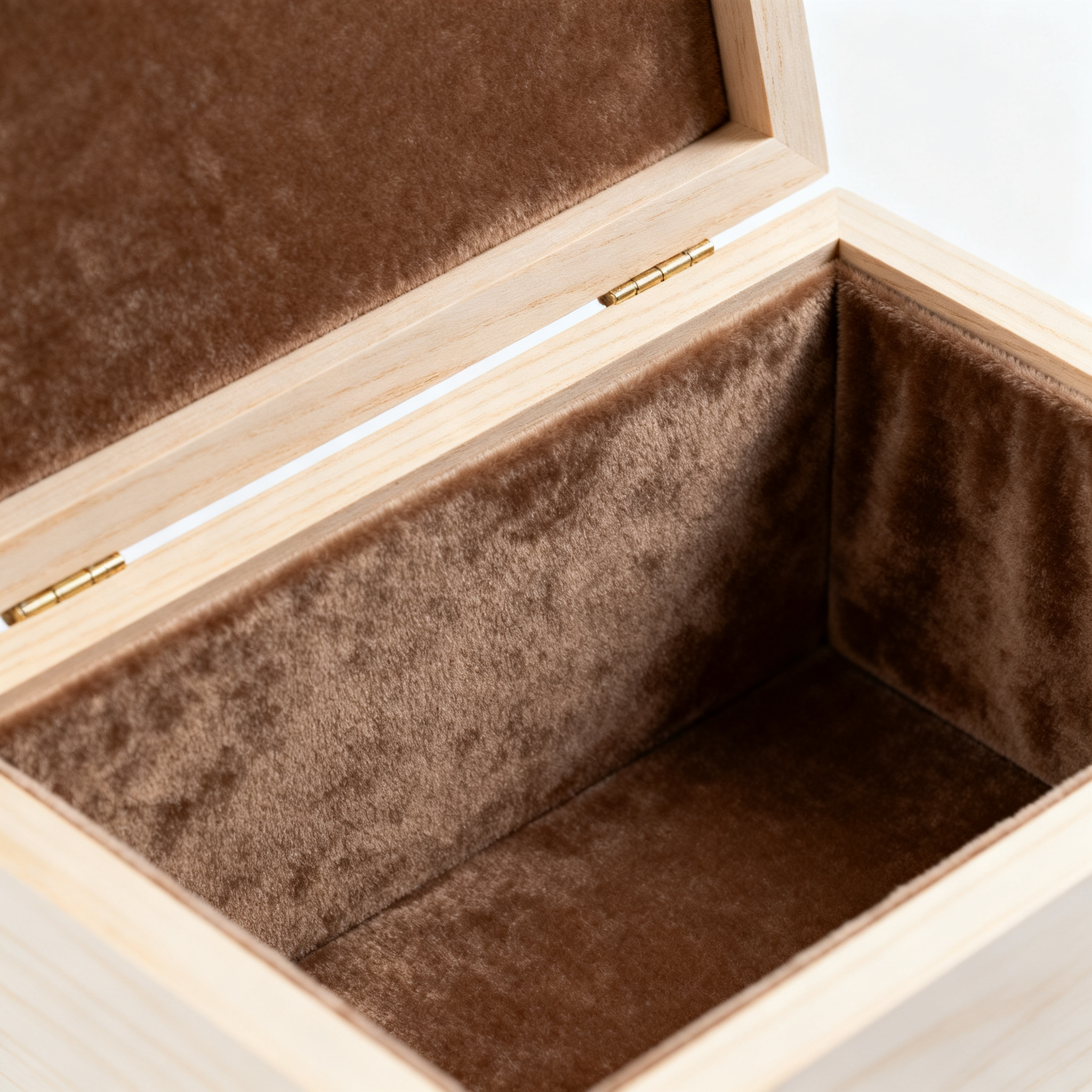
An ash bag is a soft container, and it fills the interior rather than sitting neatly inside it. The dimension that matters is the shortest inner dimension, because the bag can spread in the other two. A box with a tall interior and a narrow floor holds less than its volume suggests if the bag cannot spread. Check the inner footprint, not the diagonal.
Measuring a Bag Rather Than the Urn
Where a family is choosing a box for ashes already in a bag, measuring the bag is more reliable than measuring the pet. Bags are typically supplied in a standard size for a given weight, and their filled shape is wider and flatter than the cremated volume implies. Take the filled bag's width and depth, add a margin, and compare that to the inner footprint rather than to the nominal capacity.
Tolerance on a Handmade Box
A wooden box assembled from panels is not a moulded part, and its inner dimensions carry a tolerance of a few millimetres. That is normal and is why a capacity calculated to the last cubic inch is a false precision. Where a buyer needs a guaranteed internal clearance — for a specific bag or a liner insert — that clearance should be written as a minimum rather than as a nominal figure.
Volume Versus Linear Dimensions
Cubic inches describe capacity; millimetres describe fit. A buyer planning a range needs both, because two boxes with the same volume can differ in whether a bag fits. The conversion is 1 cubic inch to 0.0163871 litres, and usable volume runs at about 75 percent of the raw interior. A box quoted at 200 cubic inches therefore holds roughly 150 cubic inches of contents in practice.
Writing a Size Into a Specification
A usable line states outer length, width and height, inner length, width and depth, and the wall thickness. Where a photo frame or an ash compartment occupies part of the interior, state the clear depth behind the frame separately, because that space is not usable for ashes. Sizes written this way survive a supplier change and a reorder without a conversation.
Measuring for a Photo Frame Aperture
The aperture is measured as the visible opening, not the picture size. A print is usually larger than the opening and sits behind the panel, so a 4 x 6 inch photograph needs an opening smaller than 4 x 6 inches to be held in place. Measuring the opening and the print separately prevents the common mistake of ordering an aperture the size of the photograph, which leaves the print falling through.
Common Mistakes
Measuring the outer box and calling it capacity; measuring the diagonal of a rectangular box and treating it as a dimension; measuring a photograph instead of an aperture; and measuring a bag flat rather than filled. Each of these produces a box that is wrong in a way the buyer only discovers after delivery, which is why the measurement method belongs on the listing.
See the capacity guide for how volume is calculated; the size guide covers the standard range.