How a lid shares its thickness between a photograph and a sealed ash space, and the clearance to write into a spec.
A photo frame on the lid and an ash compartment inside it compete for the same few centimetres of wood. Buyers specify both and are surprised when the box arrives with a shallow ash space, or with a photograph that sits proud of the surface.
Two Features Sharing One Lid
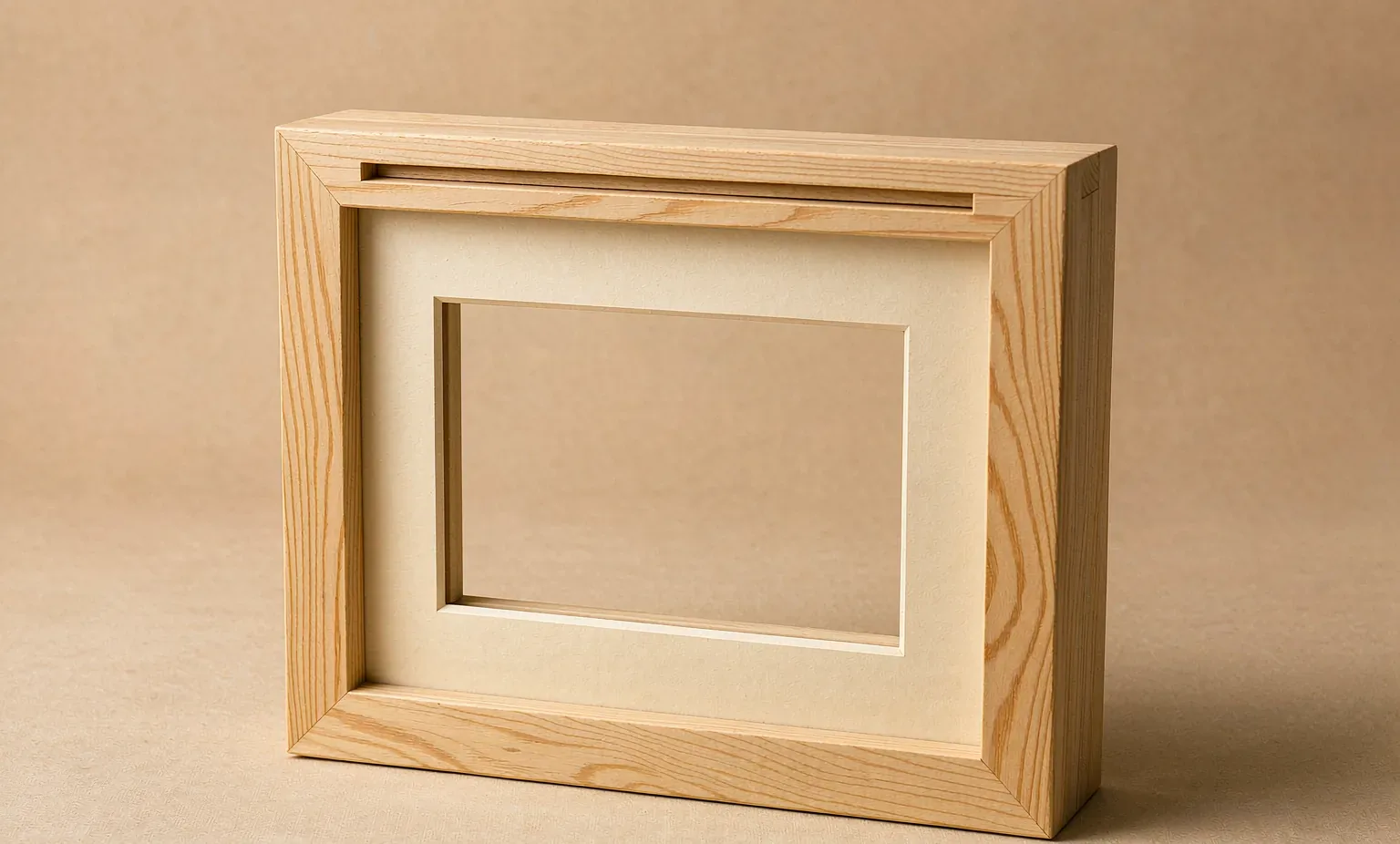
A framed lid carries three layers: the photograph or print, a transparent cover, and whatever holds the cover in place. An ash compartment needs depth behind that assembly, and the lid panel is the material both draw on. The design question is not whether the features fit, but how the thickness is divided.
Where the Depth Goes
On a typical lid, the panel is somewhere between 12 and 20 millimetres thick. A print plus an acrylic cover plus a retaining rebate takes 5 to 8 millimetres, which leaves the rest for the ash space and the lid's structural section. Deepening the frame without reducing the ash space means either a thicker lid or a raised frame on top, and both change the look of the box.
Aperture Versus Print Size
The aperture is the visible opening; the print is larger and sits behind the panel. A 4 x 6 inch photograph needs an opening smaller than 4 x 6 inches so that the edges are held. Artists and families often supply a print cut to the aperture size, which then falls through because there is nothing behind it to catch the edge.
Glass, Acrylic and Print Thickness
Acrylic is the usual choice because it is light and does not shatter into the box. Glass gives a clearer image but adds weight and risk. A thicker acrylic protects the print better but eats depth and slightly softens the image; a thinner one saves space and looks sharper. The print itself has a thickness too, and a mounted print is deeper than a plain photographic paper.
Drawer Versus Fixed Compartment
A small ash drawer beneath a frame is easier to load and keeps the photograph undisturbed, but the drawer mechanism needs clearance and adds a part that can be lost or jammed. A fixed compartment behind a removable panel is simpler and more robust, but loading it means taking the frame apart. For a keepsake portion, the fixed compartment is usually the better trade.
Tolerance and Clearance
The frame opening, the print, the cover and the compartment all carry tolerances, and they compound. If each part is built to plus or minus half a millimetre, the assembly can be a millimetre out, which is enough for a print to sit loose or a cover to bind. Writing a minimum clear depth, rather than a nominal one, is how the specification survives that stack-up.
What to Write Into a Spec
State the aperture size, the print size, the cover material and thickness, the clear depth behind the cover, the volume of the ash space, and whether the compartment is fixed or a drawer. Those six items are what a factory needs to build the lid once rather than three times. Add a statement of what the ash space is not: it is a keepsake volume, not a full urn capacity.
Checking a Sample
On the sample, check three things: that the print sits behind the cover rather than in front of it, that the cover does not rock, and that the ash space holds the intended amount with the panel closed. A photograph of the sample from the side shows the depth division better than a front view, which is why side photographs belong in the approval pack.
See the memorial set guide for how the pieces are combined; the aperture entry explains the opening measurement.