Which hardware fails first on a wooden urn, why moisture matters to metal parts, and what to specify for a long service life.
Hardware is the smallest part of a wooden urn and the first thing that fails. A lid that sags, a catch that no longer holds, a screw that spins in its hole — all of these end the piece's useful life long before the wood does. This guide covers the parts, the failure modes and what to write into an order.
The Parts That Fail First
Hinges fail first because they carry load and move. Catches and magnets fail second, usually by losing alignment rather than by breaking. Screws fail third, by stripping the wood around them when they are over-tightened or driven into a thin section. Everything else — lining, bag, finish — is cosmetic by comparison.
Hinges: Recess, Screws and Swing
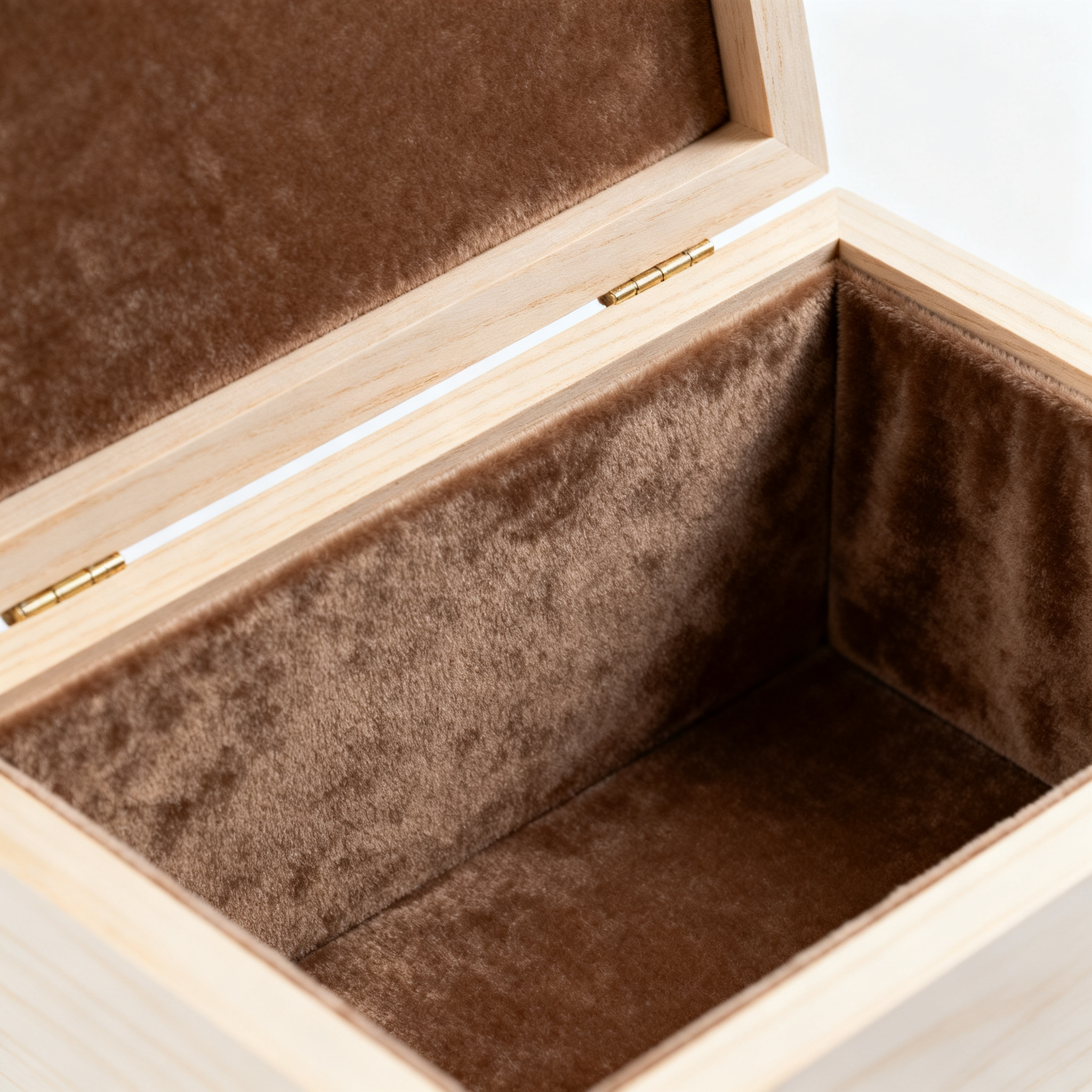
A hinge needs a clean recess so the lid closes flush, screws long enough to bite without breaking through the lid, and a swing that does not strain the leaf at the end of travel. A hinge fitted to a thin lid concentrates load in a small area and eventually pulls out. Where the lid is light, a smaller hinge is better than a heavier one, because the failure is usually the wood around the screws rather than the hinge itself.
Catches and Magnets
A catch or magnet holds the lid closed rather than sealing it. The practical failure is alignment: after the wood moves slightly with the seasons, a catch that was perfectly aligned at assembly sits a millimetre off and stops holding. Magnets tolerate small movement better than mechanical catches but provide no positive lock. Where a lid must stay shut in handling, the closure should be a screw-down or a hinged latch rather than a magnet.
Screws and the Risk of Over-Torque
Driving a screw until it stops feels correct and is the most common cause of stripped holes. In softwood the thread cuts its own path, and one extra turn removes the material the thread was bearing on. Pilot holes sized to the screw, and a stop before the head crushes the surface, are the two controls. Where a screw must be removable — a screw-down lid, for example — the hole should be able to survive more than a few cycles.
Metal and Moisture
Hardware sits inside a wooden box that moves with humidity, in a room that may be dry or damp. Ferrous parts without adequate plating corrode, and corrosion products stain the wood and the lining. Brass, plated steel and stainless options behave differently in a damp climate, and a buyer shipping into a humid market should say so rather than assume the standard fitting is adequate.
Testing Hardware Before Release
Before a new size is released, the hardware is cycled and the fit checked with the lid loaded. Testing on an empty box proves very little, because the load on a hinge comes from the lid plus whatever the closure is holding. A sample that has been opened and closed repeatedly is a better reference than one that has only been assembled.
Spare Parts and Field Replacement
Hinges and catches are replaceable, and buyers who sell at retail sometimes want a small spare kit. Supplying spare parts is easy on stock lines and harder on custom work, where the hardware may be specific to one size. Where a line is expected to stay in the catalogue for years, keeping the hardware standard across sizes is a quiet advantage.
What to Specify
Specify the closure type and the hardware material, state that the lid must close flush with the hardware fitted, state the expected climate if it is humid, and require the hardware to be tested with the lid loaded. Those four points cover most of what goes wrong, and they cost nothing to add to a specification sheet.
See the lid closure guide for how closure types differ; the build overview explains how hardware is fitted after finishing.